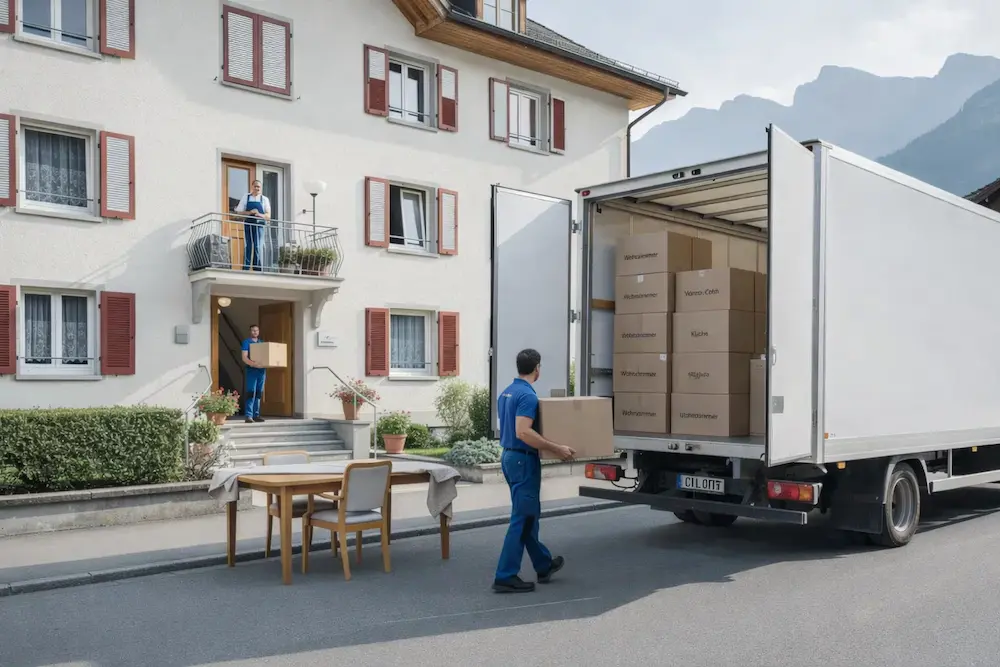

Not every change of accommodation is a complete move. Sometimes only a sofa, a wardrobe and a few boxes are transported; sometimes part of the household leaves first, while the rest is stored or follows later. A partial move may be appropriate if the mandate is clearly delineated. Without an inventory list and precise access instructions, misunderstandings quickly arise.
What a partial move means

A partial move includes a selection of objects defined in advance. This concerns, for example, the transport of individual furniture between two dwellings, a move from a furnished room, the distribution of a household or the delivery of furniture from a depot. It is not the number of pieces that counts, but the actual volume, the nature of the objects and the effort at both addresses.
A small transport is often even more restricted: few objects, a collection location and an unloading location, few additional services. Providers use these terms differently. So describe the service rather than relying solely on the name.
When a partial move might be wise
- Furnished accommodation: only personal furniture and boxes leave.
- Separation or distribution of household: a clearly marked part of the inventory changes location.
- Moving in stages: the dates for handing over the keys do not coincide and the household is moved in several installments.
- Studies or shared accommodation: the volume is limited, but some objects are too large for a private car.
- Purchase or transfer: second-hand furniture must be removed, protected and brought to the place of use.
Fewer items does not automatically mean a simple mandate. A single heavy cabinet on the fourth floor may be more demanding than several boxes with elevator access.
The inventory list as basis for the quote
Establish a numbered list. For each piece of furniture there are dimensions, estimated weight, condition and the question of dismantling. For boxes, indicate the number and approximate size. Photograph large objects and mark what explicitly should not be transported.
| Information | Why it is important |
|---|---|
| Dimensions and photos | The vehicle, the protective equipment and the carrying route can be planned. |
| Floor and elevator | The need for personnel and time becomes visible to both locations. |
| Disassembly | Tools, labeling and reassembly are calculated as service. |
| Fixed dates | Collection, access to keys and waiting times can be coordinated. |
| Fragile objects | Protection and handling are agreed upon advance. |
Check access to collection and destination addresses
Indicate the floor, elevator dimensions, shape of stairs, width of doors, distance to parking and any access restrictions. Check whether assembled furniture fits through doors and corners. Inform the management or concierge if an elevator must be reserved, open access or protected common areas.
For multiple pickup locations, each address needs its own list. Otherwise, it remains unclear which object is loaded where and whether the order corresponds to the vehicle.
Partial move, grouping or own transport?
A grouping can be more flexible over time, because the free capacity of the vehicle is used. Ask about pickup and delivery windows, interim storage and labeling. Fixed direct transport is generally easier to plan if the items are needed the same day. Doing it yourself is only suitable if vehicle, carrying aid, tie-down and aids match the inventory and access.
Do not compare these variants only on the final price. Consider reliability of dates, transshipments, protection, assembly and liability for damage.
Clearly define the scope of services

- Portage from the location to the vehicle and from the vehicle to the destination part
- Protective covers, edge protection and securing in the vehicle
- Disassembly and assembly with clearly named furniture
- Packing or unpacking of cartons
- Intermediate storage or grouping, if agreed
- Elimination only for expressly designated objects
- Approach, parking and possible weather waiting
A “flat rate transport” position is not sufficient if the quotes contain different services. The existing guide on checking moving quotes helps with the comparison.
Delivery and control
Number furniture and boxes according to the inventory list. Photograph fragile or already damaged areas before removal. At destination, check the number, visible condition and agreed location. Document discrepancies factually in the handover protocol and report issues according to contractually agreed procedures.
Realistically coordinate the date and delivery of keys
During a partial move, several appointments often overlap: collection from a private home or deposit, access to keys, elevator reservation and presence at destination. Define a time window and a contact person who can be reached by address. If you choose to consolidate, do not schedule large items for the same evening unless a firm delivery window is guaranteed.
Check in advance where the vehicle can park legally and without long porterage journeys. A greater distance between the entrance and the parking lot can influence the mandate more strongly than the distance between the places, when it comes to some heavy furniture.
Cost factors without fixed assumptions
For a partial move, volume, weight, number of carriers, distance, floors, elevator, carrying route, dismantling, protection and flexibility of dates are the main bases of calculation. Ask if billing is by time, flat rate or piece rate and what assumptions apply. A fixed price quote is only meaningful if the complete inventory list constitutes the contractual basis.
What should not be mixed with transport
Disposal, move-out cleaning, electrical connections and wall fixing are separate services. They can be combined, but must be described separately. This way you can see if a provider is really cheaper or if they simply take less care. Report changes to the list in writing before the appointment and have them confirmed again.
Plan the partial move and clearly delineate the services
A partial move is especially worthwhile if inventory, addresses, dates and additional services are precisely defined. This is not a reduced flat rate move, but a separate mandate with a precise list of parts. Online-Offerten.ch does not carry out the transport itself. With a non-binding request, you can send the same service description to suitable service providers and compare the responses in a structured way.