
Flat clearance costs in Switzerland: prices, guide values and quotes
Depending on the size and condition, clearing out a flat in Switzerland costs around CHF 500 bis 5'000. For a 3.5-room flat, the guide prices are CHF 1'000 – 1'800 including transport and professional disposal. Billing is usually per cubic metre (CHF 90 – 180/m³) or per hour and person (CHF 70 – 95).
- 100% free & non-binding
- Verified clearance companies
- Up to 5 quotes
Complete clearance including disposal
Guide prices at a glance
- 1.5 rooms
- CHF 500 – 900
- 2.5 rooms
- CHF 800 – 1'400
- 3.5 rooms
- CHF 1'000 – 1'800
- 4.5 rooms
- CHF 1'500 – 2'600
- 5.5 rooms
- CHF 2'000 – 3'400
- Detached house
- CHF 2'500 – 5'000
Non-binding guide values including VAT for normally furnished properties. Condition, access and hazardous waste change the price.
How much does it cost to clear a flat in Switzerland?
The price of a clearance is made up of three blocks: working time, transport and disposal. The disposal portion is regularly underestimated - depending on the property, it accounts for 30 to 50 percent of the bill because almost every landfill and every incineration plant in Switzerland charges based on weight.
The following table shows guide values for a complete clearance with swept-clean handover, each for a normally furnished property without special cases.
| Property | Volume (guide value) | Complete clearance |
|---|---|---|
| 1.5-room flat (30–45 m²) | 8–15 m³ | CHF 500 – 900 |
| 2.5-room flat (45–65 m²) | 15–25 m³ | CHF 800 – 1'400 |
| 3.5-room flat (65–85 m²) | 20–35 m³ | CHF 1'000 – 1'800 |
| 4.5-room flat (85–110 m²) | 30–45 m³ | CHF 1'500 – 2'600 |
| 5.5-room flat (110–140 m²) | 40–60 m³ | CHF 2'000 – 3'400 |
| Detached house incl. cellar & attic | 50–90 m³ | CHF 2'500 – 5'000 |
All information is a non-binding guideline including VAT for Switzerland. Experience shows that prices in Zurich, Geneva and Zug are above average, and below average in rural regions.
Cubic meters, hourly or flat rate: how clearance companies calculate
If you want to compare quotes, you must first know which model is being used. Two quotes with the same total amount can contain completely different risks.
| Model | Guide price | Best suited for |
|---|---|---|
| Per cubic metre | CHF 90 – 180 pro m³ | Clearly estimable volume, typical household goods |
| Per hour and person | CHF 70 – 95 pro Stunde | Small partial clearances, unclear scope |
| Fixed price after inspection | Objektabhängig | Full clearances, deadlines with handover pressure |
In the case of a full clearance, the fixed price after inspection is usually the better choice: if the company misestimates the volume, they bear the risk and not you. An hourly rate without an upper limit, on the other hand, is only fair if the scope and estimated duration are recorded in writing.
Estimate the volume yourself: this is how much m³ there are in your flat
Because almost every quote depends on the volume, it is worth making your own estimate before you inquire. This means you can immediately see whether a quote is realistically calculated or whether the company will recalculate it later.
| Area | Normally furnished | Heavily cluttered |
|---|---|---|
| Living room or bedroom | 6–10 m³ | 12–18 m³ |
| Kitchen incl. appliances | 5–8 m³ | 10–14 m³ |
| Cellar or attic | 4–8 m³ | 10–20 m³ |
| Garage or parking space | 5–10 m³ | 12–20 m³ |
| Balcony, terrace, garden shed | 2–5 m³ | 6–12 m³ |
Practical comparison: A fully loaded panel van holds around 10-12 m³, a small truck around 20 m³. If you photograph the rooms in advance and send them along, you will receive significantly more reliable quotes - and you will have to coordinate a viewing less often.
Cellar, attic and garage: what a partial clearance costs
Not every clearance involves the entire flat. Partial clearances are the most common case before a move or renovation - and they are significantly cheaper because there is less volume and there is no need for a clean handover.
| Partial clearance | Guide price |
|---|---|
| Single room | CHF 250 – 500 |
| Cellar compartment or attic | CHF 300 – 700 |
| Garage or indoor parking space | CHF 350 – 800 |
| Individual furniture, bulky waste | CHF 40 – 120 pro Stück |
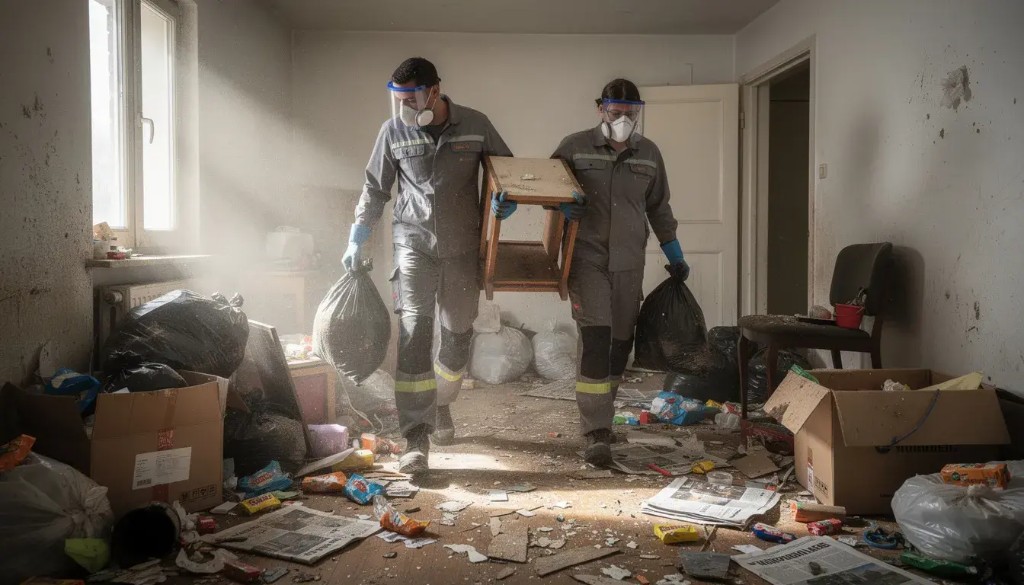
| Hoarder property (with special cleaning) | Aufschlag 50 – 150% |
For hoarder properties and heavily polluted flats, protective equipment, disinfection and often odor treatment are also required. Such orders cannot be reliably calculated over the telephone - an inspection is essential here.
Surcharges and cost traps that only appear on the final invoice
Most price differences between quotes do not arise from the hourly rate, but from items that one company includes and the other does not. Clarify these points before you sign:
Upper floors without a lift
From the third floor without a lift, the effort increases significantly. A CHF 50–250 surcharge is usual, and even more in very narrow stairwells.
Holding permit and carrying distance
Where no vehicle is allowed to stand directly in front of the house, a permit or a longer carrying path is required. Both cost time and are regularly charged separately in cities such as Zurich, Bern or Basel.
Hazardous waste
Paints, solvents, batteries, fluorescent tubes, used oil or tyres must not be placed in the bulky goods container. They are billed according to quantity and belong as a separate item in the offer.
Suspected asbestos
In buildings built before 1990, floor coverings, panel adhesive or Eternit may contain asbestos. Professional removal requires approval and is the responsibility of specialized companies - never part of a normal clearance fee.
Appointment at the end of the month
The last days of the month and Saturdays are the most sought-after slots for clearance companies. Expect a 15–30 Prozent surcharge or deliberately schedule the appointment earlier.
Sweep or move-out cleaning
Broom clean means roughly swept. If you have to hand in the flat, you also need a move-out cleaning with handover guarantee – that's around CHF 4–10 pro m².
Value credit: when the clearance actually becomes cheaper
Many clearance companies recycle usable household goods and take the proceeds into account. This works - but much less often and on a smaller scale than advertising promises suggest. A partial reduction is realistic, rarely a zero calculation. A completely free clearance requires that the proceeds from the sale cover the entire cost.
Typically credited:
- Well-preserved branded kitchens and built-in appliances with a few years of operation
- Antiques, art, watches and collectibles – Have the value appraised before clearing
- Workshop machines and tools, often more usable than home furniture
- Metal in larger quantities, which goes through the scrap trade
On the other hand, normal living room furniture, upholstered furniture, mattresses and older household appliances hardly count. The used market for this is practically saturated in Switzerland.
The most reliable way to save is to reduce the volume yourself before clearing. second-hand shops and non-profit organizations often pick up furniture and appliances in good condition free of charge. Less volume means fewer cubic metres - and the cubic metres are the price driver.
Disposal in Switzerland: what costs what
The Swiss waste disposal system is strictly separate, and some of it has already been paid for. Anyone who knows this can immediately recognize when a quote includes positions that would be free.
| Material | Route | Cost |
|---|---|---|
| Electrical appliances, electronics | Take-back in stores and at collection points (advance recycling fee) | Free upon delivery |
| Batteries, paints, chemicals | Return to retail or hazardous waste collection point | Mostly free, pick-up costs a fee |
| Metal, cardboard, paper | Recycling via collection point or depot | Free to low cost |
| Bulky goods, furniture, mattresses | Community collection or delivery to the factory yard | By weight or bulky goods brand |
| Building rubble, plumbing, floor coverings | Skip or direct delivery | By weight, often the most expensive item |
Each municipality sets its own fees and collection dates, so it's worth taking a look at the website of your local municipality. Anyone who meets the regular bulky goods deadline can get rid of part of the volume at no additional cost. Details about individual materials can be found on our page on professional disposal.
Clearance after a death: costs and legal situation
After a death, time pressure quickly arises because the rent continues. Nevertheless, the order is more important than the pace.
With the inheritance, the rights and obligations of the deceased person in accordance with Art. 560 ZGB passed on to the heirs. This also includes the current rental agreement and the obligation to return the flat. If the renting person dies, the heirs can terminate the contract in accordance with Art. 266i OR with the statutory deadline for the next statutory date - this limits the ongoing costs.
If the estate is possibly over-indebted, you should pause before any clearance. Anyone who uses or disposes of household goods can be considered an heir and therefore liable for debts. In this situation, renunciation of the inheritance or a public inventory come into question. Both are subject to deadlines and require professional advice.
This order has proven itself:
- Secure documents – ID cards, wills, rental agreements, insurance policies, bank documents, current subscriptions
- View valuables - Have jewelry, watches, art and collections valued before clearing
- Clarify financial situation - only then decide whether the inheritance will be accepted
- Terminate the rental agreement - clarify the deadline and date in writing with the administration
- Order the clearance and move-out cleaning - with a buffer of several days until the flat is handed over
This overview serves as a guide and does not replace legal advice. If there are communities of heirs and the estate situation is unclear, it is worth seeking professional advice before orders are placed.
Compare clearance quotes instead of calling individually
One request, several verified clearance companies from your region – free of charge and non-binding.
Check the clearance quote: these points must be included
A quote is only comparable if all providers have calculated the same scope. Check each quote for these points:
- Estimated volume in m³ – without this information, no price comparison is possible
- Fixed price or hourly rate with number of people and estimated duration
- Disposal fees – included or separate, and up to what quantity
- Hazardous waste – how it is billed when it appears
- Condition of handover – swept clean or including move-out cleaning
- Value credit as a separate, transparent item
- Business liability insurance for damage to buildings and inventory
- Proof of disposal after completion of the work
- Date and buffer until the flat is handed over
- Payment conditions – full advance payment is unusual
How to reduce the costs of clearing your flat
- Reduce the volume beforehand: Every cubic metre you dispose of yourself lowers the price directly
- Give away useful items or have them picked up: Second-hand shops often accept well-preserved furniture and appliances for free
- Hand over electrical appliances yourself: The return is paid for, but the transport by the company is not
- Use the municipality's bulky goods appointment: Reduces the amount that is transported away for a fee
- Choose a date outside the end of the month: Often cheaper than the end of the month or Saturday
- Request clearance, moving and move-out cleaning together: One journey and one contact person instead of three
- Compare at least three quotes: Experience has shown that the range for the same order is considerable
Related pages to read next
- Compare clearance companies – verified providers in your region
- Disposal and bulky goods – professional disposal with proof
- Moving cleaning with handover guarantee – for the handover of the flat
- Calculate moving costs – if the clearance and the move coincide
- Furniture storage – if not everything needs to be disposed of
Frequently asked questions about the costs of clearing out a flat
How much does it cost to clear a flat in Switzerland?
Are you billed per cubic metre or per hour?
How many cubic metres does my flat have?
How much does it cost to clear the basement, attic or garage?
Is there a free flat clearance?
Who pays for the clearance after a death?
Is move-out cleaning included in the clearance?
How long does a flat clearance take?
What is the difference between clearing out, clearing out a flat and clearing out a household?
What evidence should I request from the clearance company?
Request clearance quotes now
Describe your property once - suitable clearance companies from your region will contact you with a quote. Free, non-binding and without agency fees.
Request free quotes →