

A move to Switzerland is an important emotional step which, in addition to the impatience to discover the new home, also involves numerous organizational and manual tasks. Once the boxes are packed, the furniture loaded and the old flat empty, attention shifts to the walls. Over the years, frames have been hung, shelves attached, mirrors installed or lamps mounted. Unsightly, dark peg holes remain. As the handover of the flat approaches, many tenants in Switzerland wonder: do we have to plug these holes at the exit? Who pays if the management company requires a takeover, and what tolerance limits apply under Swiss lease law? To avoid unnecessary stress linked to moving and deductions from the deposit, careful preparation is essential. This detailed guide explains the legal situation in Switzerland, quotes a practical procedure and compares the costs of the different solutions.
Legal bases: what does the Swiss Code of Obligations (CO) say?
Swiss lease law precisely defines the state in which a home must be returned at the end of the lease. The fundamental principle is enshrined in art. 267 CO: the tenant is not responsible for normal wear and tear resulting from use in accordance with the contract. The subject of dowel holes during the handover of the flat, however, regularly provokes discussions between the parties.
Small maintenance vs. excessive wear (art. 259 CO)
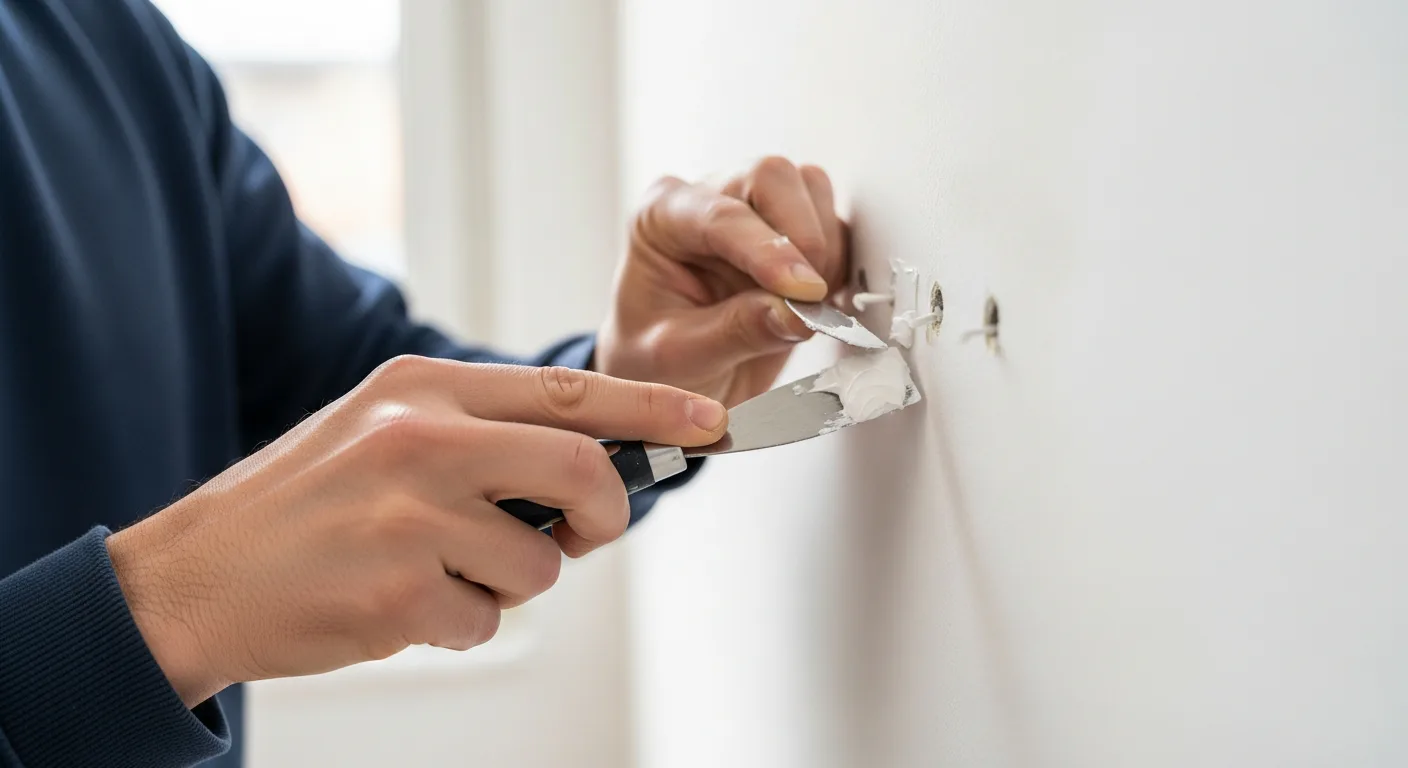
The filling of dowel holes is classified under Swiss lease law as “small maintenance” according to art. 259 CO. This category includes all the small cleaning, touch-up and maintenance operations that an average tenant can carry out themselves without special skills and at low cost. As drilling to attach everyday objects is part of the normal use of a home, the holes themselves do not constitute damage. Correctly filling these holes before handing over the keys is, however, a clear obligation of the tenant. Holes left open constitute a defect that the lessor can have corrected at the tenant's expense.
The lifespan parity table for walls and wallpaper
A central tool for clarifying questions of responsibility upon handing over the flat is the lifespan parity table, published jointly by the Association of tenants (MV) and the Owners’ association (HEV). This table defines the average lifespan of elements and materials in a home.
For wall coverings and paints, this table provides the following durations:
Simple acrylic paint (wall color) : 8 years
Quality latex paint or special paints: 10 to 15 years
Woodchip paper (painted): 10 years
Mineral coating (rendering): 10 to 15 years
This lifespan is very important for you as a tenant: if the wall painting in your home is more than 8 years old when it leaves, it is considered fully depreciated for tax and rental purposes. Even if there are dowel holes on that wall, the landlord cannot charge you for a share of the costs of a complete repainting. You are then solely responsible for correctly filling the holes. A contribution to the painting costs is not due, because the landlord would have to renovate the wall at his own expense in any case.
How many dowel holes are allowed per wall in a dwelling?
A common misconception is that a certain number of holes would in principle be prohibited or that one would be responsible for each hole independently of the total. Swiss jurisprudence here focuses on proportionality and local usage.
Tolerance limits and “local usage”
In principle, 1 to 2 drilling holes per square meter of wall surface are considered completely usual and tolerable under normal wear and tear, provided that the holes have been correctly filled. In a typical living room with several frames, a TV wall mount, and a few shelves, 15 to 20 holes can therefore exist without qualifying as excessive wear.
Excessive wear only exists if the walls have been damaged by an unusually high number of holes. Typical examples:
Installation of acoustic or soundproofing panels over a large area with dozens of screws.
A “gallery wall” with 30 small or larger holes in a confined space.
Drills in sensitive materials such as tiles, bathroom tiles or wooden paneling which cannot be repaired without trace.
In the event of excessive wear, the lessor may require the tenant to cover the costs of professional restoration of the support and, where applicable, a share of new paint, according to the residual value of the wall in accordance with the life expectancy table. life.
Question of costs: fill in the holes yourself or let the management take care of it?
Before leaving, many tenants hesitate between filling in the holes themselves or entrusting the correction to the management. The time required and the financial consequences both play a role.
Forfeits of certain authorities
If you leave dowel holes unfilled at the handover, the authority will note this condition as a defect in the report. In the Swiss real estate sector, a pragmatic formula has emerged: an internal package. Some agencies charge for the treatment of open holes; there is no legal rule such as “5 CHF per hole”. What is deducted and how much is included in the report and final statement.
Detailed comparison of repair costs
To make your decision easier, we have compared the different options for correcting drill holes in Switzerland. The prices indicated serve as a guide and may vary depending on the region and the service provider.
Material costs and possible management packages depend on the case. There is no legal package per peg hole.
If you opt for a professional provider to ensure a stress-free handover, it is advisable to compare quotes in advance. Via our platform, you can easily and free request and compare quotes to find the service provider suited to your needs.
Step-by-step instructions: correctly plug the holes drilling
If you decide to fill the holes yourself, proceed with the greatest care. A botched repair immediately catches the eye of the landlord or management company upon handover and often results in a professional repair billed at your expense.
Why toothpaste is an expensive myth
On many forums, toothpaste is presented as a free and brilliant tip for filling holes in white walls. Please note: this advice guarantees problems when handing over an flat in Switzerland. Toothpaste contains water which evaporates as it dries. The mass shrinks and becomes friable. It yellows quickly, attracts dirt and can even become moldy in high humidity. Experienced managers recognize it immediately by the smell or crumbly consistency. The consequence is a paid recovery by a professional. Instead, use professional Swiss DIY products.
Materials required for DIY repair
For a consistent result, you do not need expensive special tools. A simple DIY repair kit is enough. Obtain the following materials:
A tube of ready-to-use coating (ideally light coating based on plaster or acrylic for inside)
A small metal or plastic spatula (Japanese spatula)
Fine sandpaper (120 grit to 180)
A longer screw and a pair of pliers (to remove the anchor)
A vacuum cleaner or a small brush for dust
A little white wall paint and a cotton swab or fine brush
Practical instructions for results perfect
Follow these steps so that the holes are invisible when replaced:
Remove the anchor: Never refill over the old plastic dowel! It will come out under the coating. Instead, screw a screw by hand a few millimeters into the dowel, then remove it with the pliers.
Clean the hole: Vacuum the hole carefully with the fine nozzle of the vacuum cleaner. You can also remove plaster dust with a small brush. A dust-free support is essential for good adhesion of the coating.
Apply the coating: Insert the end of the tube deeply into the hole and press the mass until completely filled, with a slight overhang.
Smooth: Place the spatula at a flat angle against the wall and remove the excess with light star pressure from the center outwards. The surface must be perfectly flat with the wall.
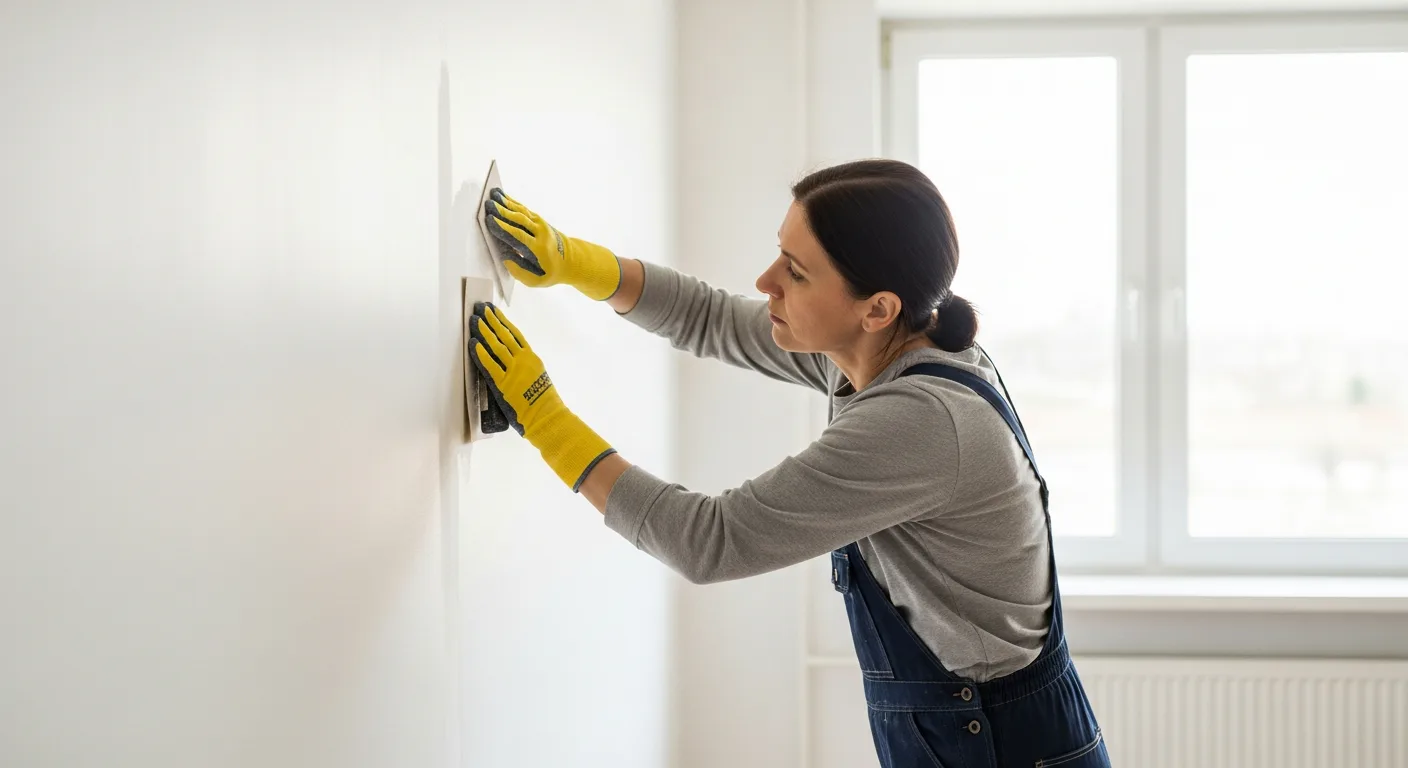
Let dry and sand: Let the coating dry according to the manufacturer's instructions (generally 1 to 2 hours). Then sand gently until no transition is perceptible.
Adapt the structure (ingrain or plaster): If your wall has a structure, dab a little damp plaster with a sponge damp to reproduce the surrounding structure.
To match the color: Carefully dab a little wall paint with a cotton swab onto the repaired area. Avoid painting in large areas, which can leave shiny spots. Dabbing optically mixes the new color with the old.
Avoid typical mistakes when handing over the flat
Handover of the flat is often rushed. Anyone who goes there without preparation risks unnecessary discussions and financial losses. Avoid the following errors to avoid compromising the reimbursement of your deposit.
Excessive filler (“denting”)
A very common mistake in DIY is the liberal application of filler without smooth sanding afterwards. Small excess thicknesses form. When daylight falls obliquely on the wall, these bumps cast sharp shadows. The management agencies are right to criticize these unprofessional alterations, because they are more visually distracting than a clean and open hole. Be sure to sand the filled areas perfectly flush.
Aesthetic tolerance: what the management must accept
There is often a fear that the filled areas will differ slightly in color from the rest of the wall. The tenants' association reassures: absolute invisibility of the repair is not legally required. Slight color variations due to natural aging and exposure to light are normal wear and tear and must be accepted by the lessor. You are not obliged to redo the entire wall at your own expense because a patched area appears slightly lighter up close.
The handover report and its legal force
Never sign the handover report without checking it under time pressure. As soon as you sign a document in which a defect (e.g. “poorly filled dowel holes”) is qualified as your obligation, it constitutes a legally binding acknowledgment of debt. The lessor can then have the repair carried out at your expense without you being able to object. If you do not agree with a remark, you must include your dissenting opinion in writing in the report or, as a last resort, refuse to sign and contact the competent conciliation authority.
Professional help: when a combined quote is worth it
For large dwellings or when the moving must be managed in parallel with a demanding professional activity, there is often no time for detailed manual work. In these cases, it makes sense to delegate these tasks to professionals.
Take advantage of the discount guarantee for end-of-lease cleaning
Most tenants in Switzerland entrust the move-out cleaning to a professional company. A big advantage: serious service providers often include the filling of dowel holes as an affordable additional service in their quote. If you compare moving companies that also quote cleaning, check for the presence of a real discount guarantee. This guarantee ensures that the cleaning company is present at the handover and takes full responsibility for the cleanliness and agreed touch-ups. If the management criticizes a patched area, it is corrected on site immediately and free of charge.
Painting work in the event of excessive wear
If the wear of the walls significantly exceeds the norm – e.g. extensive dirt, nicotine deposits or an extreme number of holes – simple filling is no longer enough. It is then advisable to call on a professional painting company. A painter properly prepares the support and ensures a uniform coat. Before ordering, always check a detailed moving quote and clarify which cost shares are your responsibility and which are the landlord's responsibility according to the joint lifespan table.
\1
The dowel holes must not be a source of sleepless nights or conflicts with the lessor upon exit. With good knowledge of Swiss lease law and structured preparation, this obstacle can be easily overcome. Whether you opt for the economical DIY method with DIY plaster or delegate the work as part of a professional cleaning with a handover guarantee – careful execution protects you from unpleasant surprises and ensures smooth repayment of your deposit.
Are you currently planning a change of accommodation in Switzerland? Use our platform to request free, no-obligation quotes for your move, move-out cleaning or possible painting work, and compare the best service providers in your region.
Here you will find additional information on suitable services: moving costs.


